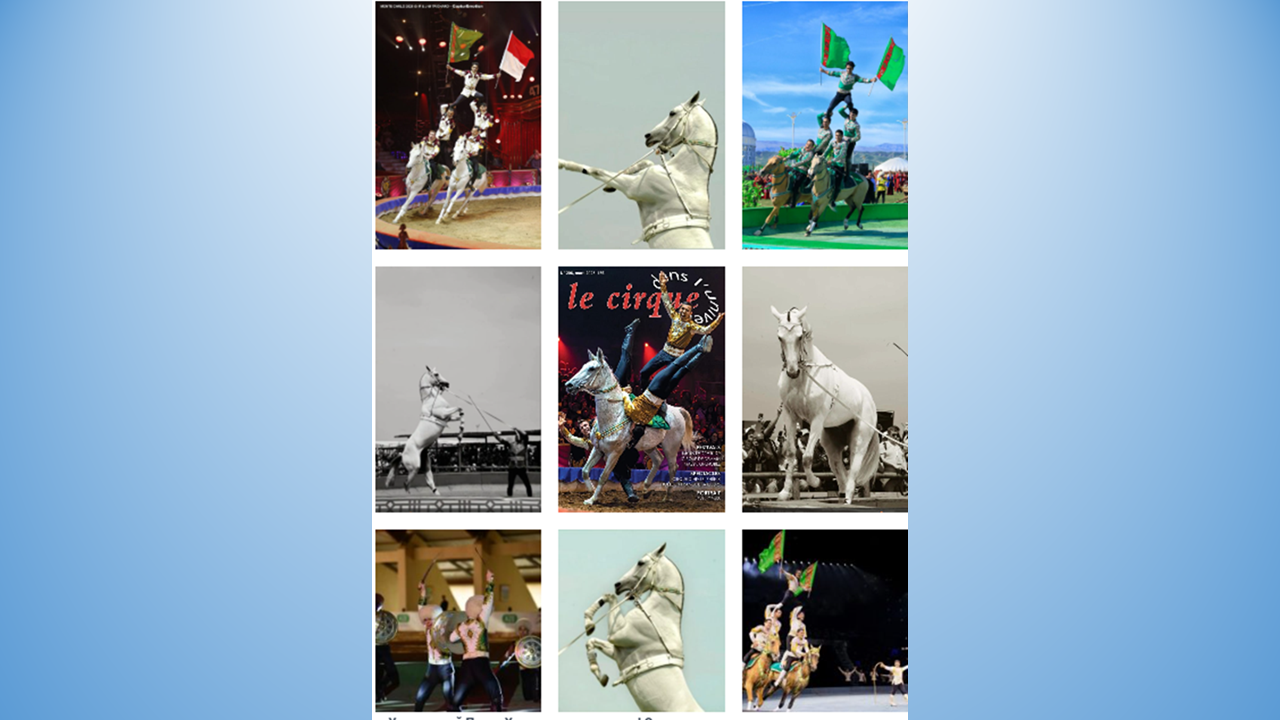
“The Circus Through a Jigit’s Eyes” — Turkmen Jigits — Galkynysh Group
I have been a fan of the Turkmen jigit troupe Galkynysh for quite a long time. Watching them feels like carefully touching something ancient, almost sacred. Their art follows its own inner laws and seems untouched by the rush of the outside world. When they enter the arena, it is not simply a performance; it is a wordless conversation. Everything speaks through movement, speed, and the way they sense one another. It is like a language that cannot be translated, yet is understood at once.
For many years, I have adored the Akhal-Teke breed of horses. When I saw that golden beauty in the arena, my heart simply stopped at the sight. Since then, I have watched the Galkynysh group with great pleasure.
Akhal-Teke horses fit perfectly into this combination of speed, artistry, and beauty. You can feel the steppe in them: fire, wind, and swiftness, together with remarkable elegance. Their coats seem to be made of gold, shifting between copper and mother-of-pearl. But what is most precious is the subtle nature of their partnership: the slightest tilt of the head, a glance—and horse and rider are already one. It is my favorite breed. I am even considering getting an Akhal-Teke for myself. To me, a horse is not merely an animal, but a companion with whom I could learn this silent dialogue, placing complete trust in one another.
You know, when people speak of Akhal-Teke day, celebrated on the last Sunday of April, you immediately picture not posters and parades, but the endless steppe and these extraordinary horses. In Turkmenistan, they are regarded more deeply than anywhere else: the Akhal-Teke is not simply a symbol, but part of the national character—a living history passed down from one generation to the next.